Showing posts with label Italy. Show all posts

Tuesday, March 21, 2006

Time is ticking. . .

It’s quite the process, but once we get all our athletes out of the Villages and headed back to the States safe and sound, we palletize all our equipment for shipment back to Colorado Springs. By equipment, I mean all recording electronics, medical supplies, strength and conditioning gear, desks, chairs, office supplies, etc. Not quite as bad as a 6 month military deployment, but a daunting task nonetheless. There is only a skeleton crew at this point, so those of us that are left have quite a lot to do. As you can see from these pictures, we pack it up, stage it all on pallets, and bring in a shipping company to do the rest. Now that this is done, we will have a farewell dinner tonight and pack our personal stuff for the flight home tomorrow. My flight leaves at 6 a.m. (3:30 a.m. airport run), and the journey home begins. We already went to our favorite local restaurant, Gaspare’s, and had a good-bye lunch and exchanged email address and bid farewell to the whole family. Gaspare’s wife had a baby just a few days ago, so we’re all anxious to see some pictures!

So, if all goes according to plan, the next post will be from the States! I stop off in Louisiana for some Daigle family lovin before I go back to Colorado. I've enjoyed my time here in Torino, but I'm ready for some clean (OK, cleaner) air and some much warmer weather!!!

Paralympic Closing Ceremonies

What a crazy day Sunday was! Instead of staging the Paralympic Games Closing Ceremonies at the Olympic Stadium like all the other ceremonies, it was held at Piazza Castella (better known as Medals Plaza during the Olympic Games). There were a few tickets for sale (if you wanted to sit down), but other than that, it was free and open to the public. Needless to say, it was a logistical nightmare for our security department! After starting the packing process of equipment for most of the day, most of us went to Closing Ceremonies to assist our athletes. This picture is from the U.S. Olympic Committee website (yet another great picture that I didn't take!).

The Closing Ceremonies themselves were quit interesting. I didn’t really understand the progression of tunes from “Singing in the Rain”, “It’s Raining Men” (with strategically placed assistants opening umbrellas in the crowd and squirting perfumed water over the spectators), to a bunch of children singing “Another Brick in the Wall.” A bit strange, but overall amusing! The confetti and fireworks were great and made up for some of the confusion!

Due to transportation logistics, most of our athletes had to be on a bus headed for Zurich only 3 hours after the Closing Ceremonies ended. So, imagine trying to round-up a group of athletes who have just had an experience of a lifetime, to get them to their planes, trains, and automobiles on time so soon after the experience has ended. Actually, it wasn’t that bad, and everyone was where they needed to be when they needed to be there.

Now, we have to finish packing up all the equipment and personnel required to put on an event (actually two events) of this scale, and head home.

Thursday, March 16, 2006

A day in the mountains

Today, I drove up to the mountain venue in Sestriere with one of our Athletic Trainers to watch the Disabled Alpine Ski events. Today was a light video taping day, so I wanted to go up and watch some of the Giant Slalom events. Today was the “stands” – athletes with disabilities that allow them to ski upright under their own guidance (as opposed to athletes who compete sitting or with a guide). I’ve done physiological testing a few times a year on this team (sits and stands) since working for the USOC, but this was the first time I’ve seen them compete. Granted, it’s my own fault - I’m too much of a wus in the cold to go stand on a hill for a day to spectate. Well, today I redeemed myself and went out on the hill for a day and watched them compete!

For those of you who wonder what I do back in the Springs, here’s a little insight into the role of a Sport Physiologist for you. Physiological testing for the Disabled Alpine Ski team consists of a Wingate test and max strength & conditioning testing. A Wingate test is done on a specialized type of stationary bike (or upper body ergometer for the “sits”) and is a test of anaerobic strength. The athlete pedals the ergometer at a steady cadence, we give them a countdown, then we add a certain percentage of his/her bodyweight as resistance (dependent upon level and type of disability), and the athlete cycles all-out for 30 seconds. From that, we can determine absolute and relative total power produced, average power over the 30 seconds, and fatigue rate. Now, you may scoff at 30 seconds, but a Wingate test is pretty tough and usually produces near-maximal heart rates, lots of lactic acid, and in some cases, a substantial amount of nausea! Although it may seem like it, this test isn’t just for kicks to torture the athletes. The test results are used by the coach to monitor progress over a season or multiple seasons and to alter training programs. The athletes aren’t particularly fond of the test, but they like getting the results, especially when it shows improvement over the last season!

So, I froze out on the hill (although everyone else was quite comfortable on this bright, sunny day), and watched our “stands” compete. I also went up the gondola into the Italian Alps for a great view of the mountains and the town of Sestriere. At the top, a Chinese Paralympian and his friends wanted to have their pictures taken with the American. We couldn’t speak a lick of each others’ language, but it’s pretty cool that most of these athletes just want to share the experience of these Paralympics with everyone – without regard for nationality or role in the Games. Most of the athletes’ families were cheering just as loudly for all the other athletes as for their own. I have to admit, I shook my spectator cowbell for every athlete that came down the hill, not just for the Americans. The stands were packed, so it was a lot of fun to be a part of so much positive energy at once.

Just another day at the Games!

Monday, March 13, 2006

Seeing old friends

This is a picture of me and my friend Ruby at the USA vs. JPN sledge hockey game last night. Ruby and I were 2 of about 20 interns at the U.S Olympic Training Center during the summer of 2003. Ruby now lives in Germany and works for Paralympics. It’s amazing how “inbred” the USOC community is. I guess the USOC isn’t so much inbred as it is a great pipeline and networking opportunity. It seems as though the majority of people that work for the USOC, Sport National Governing Bodies (NGBs), and affiliate organizations have been either interns or research associates for the USOC at one time or another. Two other alumni of the Summer 2003 USOC internship, Annie and Diane, are also employed by the USOC and are/were here in Torino in support of the Paralympic and Olympic Games. It’s so much fun to run into old friends and catch up on each others’ lives.

The sledge hockey game itself was also exciting, especially since the stands were filled! There were tons of American supporters cheering the team on to a 3-0 win over Japan.

Luci d'Artista

With the combination of baroque and renaissance architecture all around the city, it’s hard to imagine that Torino could be even more interesting and scenic at night. But from the beginning of November to the end of January each year (extended to March 20th this year for the Olympics), the City Council provides lights for what’s known as Luci d’Artista (Artists’ Lights). The streets, piazzas, and buildings of downtown Torino are illuminated by light sculptures and installations by some of the most famous European artists. It’s like Christmas lights gone crazy! The core group of light installations were started in 1988 and consists of star constellations, planetary systems, neo-pop street signs, neon mechanical birds, and human figures.

Torino is establishing itself as a contemporary arts city and was looking for a way to bring the arts to the general public. Each year, one or two new installations are commissioned. At first, the lights would stop me in my tracks each time I turned a corner and saw a new display. After living here for 6 weeks though, the displays have become landmarks by which I navigate the city at night! Just a side-note, you know you need to get off the #18 tram downtown when you see the Luci d’Artista exhibit at Piazza Carlo Emanuele II!

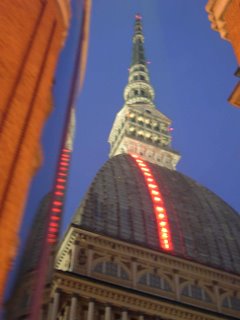
The pictures are of the Flight of Numbers (A Fibonacci sequence of Illuminated numbers ascending the landmark Mole Antonelliana tower), Planetario on Via Roma, Regno Dei Fiori in Piazza Carlo Emanuele II, Polomar on Via Po, and Small Blue Spirits on Santa Maria del Monte church overlooking the River Po.

Saturday, March 11, 2006

Paralympic Games are on!

After hearing a spirited discussion last year while working with the Disabled Alpine Ski Team, I thought it might be appropriate to use this opportunity to enlighten my friends and family about the paralympic movement. Having worked with a couple of disabled teams, there’s a few things I think is important for everyone to know. First is that there’s not much difference between able-bodied and disabled athletes. The gear they use for their sports may be different, but disabled athletes incorporate periodized training plans, weight training, have grueling competition schedules with lots of international travel, and have lots of competitive drive just like their able-bodied counterparts. Depending on the disability, nutrition is even more important for disabled than for able-bodied athletes. Unfortunately, there’s not as much sponsorship dollars in disabled sports as there is in able-bodied sports, that’s one of the reasons why you’re not able to watch the Paralympics on TV back in the States like you were able to watch the Olympics. I’ve included a link to a free webcast of the Paralympics so you can see some of our athletes compete.

One of the other things I think you should know is that this is the Paralympics, not the Special Olympics. At the risk of offending my Paralympic friends, I think the general public doesn’t really know the difference so I’ll contrast the two for you. The two major differences between the Special Olympics and the Paralympics are the differences in disabilities and the level of sports ability. The Special Olympics is for individuals with intellectual disabilities whereas the Paralympics are for elite athletes with physical disabilities. The Special Olympics goal is “to challenge each athlete to do his or her best while providing a meaningful and enjoyable experience.” The Paralympics goal is to “facilitate competition to determine the best athlete or team.” This means that there are qualifying standards for the Paralympics and that teams and/or individuals can be eliminated through preliminary play.


The Paralympics started off as a competition in 1948 for WWII veterans with spinal cord injuries. The first Olympic style games were organized in Rome in 1960. In 1976, the first Paralympic Winter Games were held in Sweden. Olympic venues are used usually, 2 weeks later for the Paralympic Games. There are 486 athletes from 39 countries here in Torino competing in Ice Sledge Hockey, Wheelchair Curling, Alpine and Nordic Skiing. All athletes are organized within five disability categories: spinal injury, amputee, visually impaired, cerebral palsy, and les autres (others).

In my biased opinion, it’s kind of fitting that the U.S. flagbearer for Paralympic Opening Ceremonies is a military veteran (photo from Torino2006 website). Chris Devlin-Young was serving in Alaska as an aircrewman in the U.S. Coast Guard when his plane crashed in 1982. He was left completely paralyzed from the knees down and partially paralyzed from the waist down. Since picking up skiing 19 years ago at a VA sponsored Winter Sports Clinic, Chris has won 2 golds and a silver medal in previous Paralympic Games. I love this quote given by him to USOC media. . . “being chosen as a flagbearer is an honor I never expected, and didn’t even dream of. I’ll be representing my country in the purest form. It’s not political. It’s not about any gains or any losses. It’s not about being the best country out there. It’s about being a country of the world, and I’m representing my little piece of it.”

Well said, Chris!

Wednesday, March 08, 2006

Cinque Terre


In the north western part of Italy, the land meets the Mediterranean in a coastal region known as Cinque Terre. Cinque Terre (Five Lands) is actually five cliffside villages along the coast between two major promontories (points of land that jut out into the sea). The villages are Monterosso, Vernazza, Corniglia, Manarola, and Riomaggiore. I had come here after the Torino Olympic meetings in May, but after being land-locked for so long and having just lived in a major, polluted metropolis for the last month, I decided I needed to see the sea! The weather wasn’t cooperating much when we first arrived in Manarola (where we stayed in a hostel), but cleared up after a storm passed through during the night. Although the exact date of establishment of the villages isn’t known, the church in Manarola dates back to the 1300s.

We woke up to a slightly chilly, but clear blue day and started hiking from village to village. The trail from Manarola to Riomaggiore is pretty much a stone sidewalk hanging over the water and is an easy 20 minute stroll. Parts of the walkway are covered and you can see amazing views of the water through arch shaped openings. This walkway is called Via Del’ Amore (Lovers’ Pathway) and has benches all along it for sitting and gazing out over the sea. The trails between all the other villages are a little more rugged, so one section was closed off due to the potential for landslides. The others were open once the sun came out, so we hiked the two remaining trails.

The trails twist, turn, climb and descend through olive and lemon orchards and family vineyards and vegetable crops. Some parts are literally along residents’ “backyards.” All along the hills are fasce, narrow strips of land on the hillside for terraced cultivation. Boundaries and stabilization are established by 2 meter high stone walls called muretti. This network of stone walls are 11,000 km long (about 6800 miles) and requires constant maintenance. I can’t imagine the amount of effort it’s taken over the years to establish this type of farming in such an inhospitable landscape and how much work it takes now to keep it going. It’s comforting to know that there is a certain amount of hard-headedness required to live along coastal areas, no matter where in the world they are!

At the end of our day of hiking, we made the 4.5 hour train journey back up to Torino. This seaside stop did wonders for my disposition, but didn’t do much for my desire to return to the city. Now that I’m back though, it’s good to be here to get things rolling for the Paralympics.

Siena

Amid cold and rainy weather, we traveled by bus from Perugia to another hillside town in Umbria called Siena. It’s a well-preserved, medieval city in the Tuscany region. The Piazza del Campo is a novelty in Italy – it’s a shell-shaped piazza (plaza). On one side of the piazza is a 289-foot bell tower, the Torre di Mangia. I’m writing this post 3 days after climbing to the very top of the bell tower and my calves are still sore, but the climb was so worth the view! After taking in the city from this bird’s eye view, we went back down to the piazza and hung out for a bit eating gelato and admiring the Fonte Gaia (Fountain of Joy). All around the piazza are restaurants and pottery shops. Several regions in Italy have their own trademark style of pottery painting and one of my favorites is of bright yellow lemons that is common to the Tuscan region. They also paint lots of sunshines too! The Duomo in Siena is an enormous black and white stone cathedral that construction begun on in 1150. Unfortunately, they still aren’t quite done yet and the cathedral was wrapped in canvas and scaffolding.

The hilly region of land between Siena and Florence is known as Chianti. For those of you who are red wine lovers, this is the Garden of Eden! Some of the best wines of Italy are produced in the Chianti region and bear the same name. I had a so-so dinner in Siena that was more than made up for by the excellent Chianti Classico that accompanied it. Maybe I was just being too hard on the restaurant since I had just experienced Tita and Nonie’s cooking! The olive oils and wines in this region make a simple afternoon ritual of a drink and snack before dinner a dining experience all its own, so dinner itself wasn’t a total loss.

Tuesday, March 07, 2006

Umbrian Cooking Class

In typical Karen travel fashion, I decided a couple of days before jumping on a train that I wanted to take a cooking class in a smaller, hill-side Italian city. Robyn was a good sport in this spontaneous travel planning and trusted that things would work out. And man, did it work out! I called the number on the UmbriaCooks4U website to see if they would give a class for only 2 people and on only 2 days notice. I was a little worried that communication would be a problem when a very Italian voice answered the phone “Pronto.”. . . "Um, do you speak English?" Instantly, the voice changes to the Bronx-laden English of Nonie, half owner of this cooking experience endeavor. "Only 2 people? And day after tomorrow? Let me check with the chef, but I think it’ll be OK." A couple of phone calls later, we’re all set. On the train to Perugia, Robyn asks what we’ll be cooking. “You know- typical Umbrian food” I answer kind of vaguely. In other words, I have no idea!
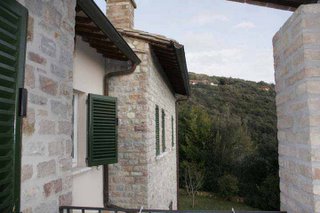
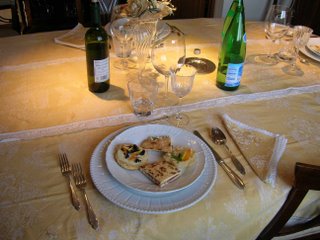
Nonie calls us the night before to make sure we know where she’ll pick us up. Perugia is full of one-way streets and no-traffic, pedestrian throughways, so she makes us do a run through so we can call her ahead of time if we have any problems. The next day, she picks us up in her yellow Panda (not the yellow Honda we were looking for) and whisks us away to Tita’s hillside home surrounded by olive trees (we used olive oil from these trees during our cooking) and one of the biggest Rosemary bushes I’ve ever seen! It was winter and she was having some work done to the outside of the house and wasn’t happy that we would see her home that way. The house and the view were unbelievable, renovations and everything.
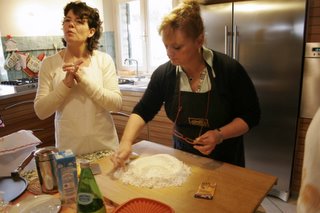
So, before I launch into the play-by-play of our cooking class, let me give you some background on Nonie and Tita’s friendship. Nonie, a native New Yorker, came to Perugia in the 70s to study Italian language (Aunt Ruth, I could totally see you in her stories!). In the process she met her future husband and became fast friends with Tita. Although Nonie went back to the States for a few years to finish school, she’s basically lived, and raised her family, in Perugia ever since. Tita is the chef and didn’t speak much English (though I think she understood every word said!) and Nonie is the interpreter/story-teller/dishwasher. The duration and depth of their friendship throughout love, life, and kids is apparent and deepens the whole cooking experience.
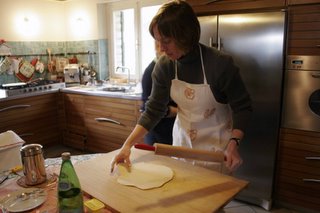
I guess I should tell yall what we cooked, huh?

Antipasti (Hors d'oeuvre)
Torta al Testo con Proscuitto Nostrale
(Flat bread with Umbrian ham)

Torta al Testo con Stracchino e rucola
(Flat bread with soft cheese and rucola)

Bruschette al Pecorino con olive all' orancia fatte in casa
(Sheeps' milk cheese bruschetta and olives seasoned with orange peels)

Cestino di Parmigiano alle Pere
(Parmesan cheese baskets with pears)

Primi (First Course)
Pasta e Ceci Tiepida
(Chickpea soup with pasta)

Carbonara di Zucchini
(Egg sauce with zucchini [over tortollini])

Secondi (Meat)
Straccetti all' alloro
(Veal strips with laural [bayleaf]

Fagiolini in forma
(Baked stringbeans [in Béchamel sauce])

Dolci (Dessert)
Torini Fondenti al Cioccolato
(Melting chocolate mold)

Gelato
(Tita's yummy homemade icecream!)

Frutta di stagione
(Seasonal fruits)

Vino (Wine)
Vini rossi e bianchi tipici DOC Umri
(Red and white Umbrian DOC wines)

Vino Passito
(Sweet wine)

Caffe' (Coffee)
(Espresso)


So, we set out looking for an authentic Italian cooking experience and that’s exactly what we got. We cooked in Tita’s home kitchen. It was definitely a chef’s kitchen, but not an industrial one. Her son was home from school and taking a nap while we were cooking and came out later to see what we were cooking and to chat for a bit. At the end of dinner, Tita’s husband came home from work and contributed to the lively table discussion. By the end of the whole experience, we had Tita and Nonie showing us photos from when they first became friends and some of the family vacations they’ve taken together over the years. We got more than an authentic Umbrian cooking class, we got two wonderful, talented women opening their homes and lives to us in a way that made us feel more like friends than cooking students. I can honestly say - this day was the highlight of my stay in Italy.

Perugia


My original plan for the Olympic-Paralympic break was to go down to Rome for 4-5 days of art and ruins sightseeing. After a month in the pollution and traffic of Torino, however, I just couldn’t bring myself to go to another city with more than a couple hundred thousand people. The rainy, overcast weather didn’t exactly light a piazza-touring fire in me, so I got on the internet and found a cooking class in an ancient hill-top town called Perugia in Umbria (just below Tuscany). My friend and co-worker, Robyn, is also staying on for the Paralympic Games, so she came with me on my jaunt to central Italy.

We went to Perugia the day before the cooking class was scheduled and explored the ruins of an enormous 16th century citadel. Not only is the city built around this massive structure, it takes advantage of the numerous caverns and corridors within it with a sort of underground shopping/arts center. Being a hillside town, there are never-ending mazes of stairs and steeply inclining walkways (notice the people in the picture by the building for perspective on the stairs). We were beginning to think this must be the most in-shape population we’ve ever encountered if they are able to navigate this landscape everyday- especially carrying groceries. We got suspicious when someone gave us directions using the “escalators” as a landmark. Is that the Italian word for stairs we wondered? As it turns out, the city is also full of outdoor, American mall-type, covered escalators!

On this trip, I introduced Robyn to the joys of backpack traveling by finding us a place to stay at a youth hostel in the middle of the town. OK, I can hear some of you chuckling under your breath from here at the “youth” part of hostel! No, there’s no age limit and they let me stay!! We stayed in a historic old building with frescoed ceilings, a community kitchen, and amazing views of the city and Umbrian hills. You can tell a lot about a person by the guide book in which they are traveling from. If you see someone clutching a Fodor’s, AAA, or Rick Steve’s guidebook, you can be pretty sure they are traveling with roll-type, handled luggage and either rent cars or take taxis most of the time to get where they need to go. There’s nothing wrong with traveling that way, but I myself am a Lonely Planet type of traveler – low maintenance, low budget! This means I don’t mind staying in a hostel, which are places that rent rooms with bunkbeds and house same-gender travelers in the same rooms. They almost always have down-the-hall bathrooms, communal lounges and kitchens, and are always dirt-cheap compared to hotels in the area (15 euros vs 40 euros per person per night)). Levels of cleanliness vary, but for the most part they are always safe and tidy. The major drawback, or benefit depending on how road-weary you are, is that every other English speaking backpacker also has a Lonely Planet guidebook from which they are traveling. It's fun to meet up with Aussies and Brits to hear about their travels, but you're not meeting the locals of the country you're in by doing this.

There’s a good deal of flexibility and patience required with this type of travel (I’m hearing that chuckling again with the word “patience” being used in the same sentence with Karen!). I like the adventurous aspect of this type of travelling. There's a certain amount of personal satisfaction that comes from being able to figure out public transport in a foreign language. For me, taking a taxi is like admitting defeat and that I couldn't figure it out! I suppose at some point I'll outgrow this type of travel and prefer a hotel room with towels and sheets included, but for now (and with the right travel partners!), this is still fun for me. I have to admit though. . . room service sounds pretty good sometimes too!

Also part of the backpacking experience is navigating a city and public transport with your backpack. I try to be as much as a minimalist as possible when I travel, but this is winter traveling! I still managed to stuff a week's worth of winter clothing into a medium-sized backpack. When we arrived in Perugia’s train station and inquired as to the direction of the ostella (hostel), we were told that since it was a 3km, uphill journey, we should take a bus to the center of town. "No, that’s OK, just point us in the direction of the center and we’ll walk". After a few glances of confusion followed by amusement then envy, Robyn and I strolled the mile and a half up-hill to the town center. Who’s chuckling at this 38 year old now?!

That’s it for now, I have to go see how much work piled up while I was away, but I’ll post about my cooking class experience later today!

Monday, March 06, 2006

Back from vacation

It's 10:30 p.m. and I just got back from 5 days of vacation (because you can tell from my posts that my life is all work here!). I'll do a post in the morning when I'm fresh and attempt to bring yall up to date on my latest adventures.

Tuesday, February 28, 2006

Time for transition. . .


This is a picture of the Closing Ceremonies at the Olympic Stadium (can't take credit for this one, it's from the Torino 2006 website!). I wasn't at the closing ceremonies, I was taping them in our technology area. It was sort of surreal – I was watching the fireworks on the screen, but feeling and hearing them at the same time. It’s hard to believe that the Olympic Games are over already!

But, that doesn’t mean it’s all over. Ever since closing ceremonies, we have been in a transition phase from Olympics to Paralympics. Most of the operations will be the same, albeit in a smaller scale. We have 55 American athletes with disabilities that are coming to Torino to compete in the Paralympic Winter Games from March 10-19. There will be over 500 athletes with disabilities from 41 different countries competing in 4 unique sports (alpine skiing, Nordic skiing, sled hockey and wheelchair curling). So, my time in Italy is counting down to March 22 (after packing up is done for Paralympics). I've added a link to the U.S. Paralympic website for yall to learn more about it.

After all our Olympians depart and before our Paralympians arrive and we start working the Paralympic Games, I am hoping to take a trip to somewhere else in Italy. I’ll know more in the next couple of days, so please stay tuned for more posts!

Sunday, February 26, 2006

Competitons and meals


Wow, what a fun night! Last night, I was at Short Track Speed Skating for the men’s 500m and the men’s 5000m relay. Apollo had the perfect race and skated his way to a gold medal in the 500m. In the last event of the evening, our men’s team won bronze in the 5000m relay. I believe that sport represents a lot of things to a lot of different people. For some, playing organized sports while growing up taught them teamwork, dedication, commitment, and work ethic. For those of us who weren’t as athletically gifted, we developed those skills and characteristics through other venues- for me it was through the military. No matter how gained though, it’s a pretty emotional scene to witness those characteristics come to fruition at the highest level. Patriotism needs something to keep it burning, and National identity at the Olympics seems to work just as well as any other fuel at times.

After lots of jubilation and celebration, we left Palavela arena close to midnight in search of dinner. We stopped in at a little Pizzeria on our way back to the hotel and got a great slice of pizza for 2 euro! As is quite often the case, the place was run by a husband and wife team. They couldn’t speak much English and we couldn’t speak much Italian, so it was a little awkward at first trying to share our enthusiasm with each other (the Italians have done quite well during these Games also!). We stumbled around broken pieces of language for a while until they noticed the U.S. flag on our coats and wanted to know what state we were from. We answered that we came from Colorado and the husband got quite excited and went into a back room. When he returned he came out holding a postcard. After much sign language and laughter, we determined that he collects postcards and wanted us to send him one from Colorado! After the ice was broken with the postcard, we managed to communicate and laugh for quite some time before making our way home. Once again, the hospitality of Torino shone through and we got so much more than just a meal.

Friday, February 24, 2006

Torino - The good, the bad, the ugly!

As the Games are winding down, some of our staff is starting to depart back to the States already. Reminiscing over our experiences in Torino and the uniqueness of this city, we’ve come up with the good, bad, and ugly of Torino, Italy.

The good – almost too numerous to mention!
- Without a doubt, the pasta (never overcooked)
- Chocolate
- coffee (oh, the coffee!)
- wine
- architecture
- public transport
- leisurely dining
- divine gelato
- lots of walking
- families hanging out together
- recycle bins everywhere
- friendly folks
- family-run restaurants (like being at home, but you don’t have to do the dishes)

The bad
- even with many areas of beautiful, historical architecture, Torino is still a polluted, industrial city
- leisurely dining (a double-edged sword!)
- Italian driving (notice the car parked on the sidewalk in the picture)
- warm milk (and forget about finding skim)
- no breakfasts (unless you consider coffee and cigarettes a complete meal)
- no dinner before 7:00 p.m.
- afternoon siesta (will always fall at the only time you have available to conduct business)
- invisible street signs (do they really think a stone sign with 12-point font letters stands out against stone?) Try to find the street name in the picture of the street corner. Now imagine trying to read that at 60 kph with cars honking all around you!

The ugly
- Kleenex full of black, pollution-saturated snot at the end of each day
- public transport (another double-edged sword!)
- dog poop on EVERY walking surface in the city
- pointy shoes (OK, matter of personal opinion)
- relentless traffic noise (Italians love their horns!)
- although not as common as in more Eastern countries, I’ve run into a few of these toilets in Torino (see picture). You don’t bring reading material into these unless you’ve got thigh muscles like Hercules!!

Wednesday, February 22, 2006

Olympic pins


The Olympics is like a circus that rolls into town. It’s not just the Games that are happening, there’s the whole spectacle of the Games that happens. One of the more amusing (and sometimes annoying) side shows of the Olympics is pin trading. Every country, sponsor, sport, etc. has its own pin for the Olympic Games. The designs range from national flags and sport emblems to cartoons and works of art! There are official pins and “renegade” pins, but each has its own character and some are more coveted than others. Everyone in the USA delegation is issued about 15 Team USA pins and 15 USA sport/staff specific pins.

The professional pin traders present a much more enjoyable experience than the SWAGgers. The “professionals” are people who come from all over the world just to trade Olympic pins. If you check out ebay, you’ll see that Olympic pin trading can be big business. It seems that for the most part though, these folks do it just for the fun of it. I’m not really into the whole pin-trading scene, but just to see what some of the ones from other countries look like, I checked out one guy’s collection. He saw one of my Team USA pins and asked which pin of his I’d like to trade it for. When I told him I’d just give it to him, he actually seemed disappointed that I didn’t want one of his in return!

The official definition of the acronym SWAG is “sundries, wearables, and gifts” used by marketing departments to describe free stuff they hand out as promotions. To everyone else, it means “stuff we all get.” The SWAGgers are the people who feel that they are entitled to your Olympic pin. SWAGgers can be your waiter or the security guy running your stuff through the metal detector. It’s always awkward when you only have a couple of pins on you and your saving it for some little kid who recognizes the American flag on your sleeve and smiles at you or the waiter who patiently takes 20 minutes to explain the menu to a group of people who can’t speak a lick of Italian.

Just thought yall would like to hear a little bit about the side shows of the Olympics!

Tuesday, February 21, 2006

A night to celebrate!

Last night, quite a few of us USOC staff went to the bronze medal women’s hockey game. Even though there was some lingering disappointment on our team that they were playing in the bronze medal game instead of the gold medal game, they came out fired up and ready to go. They would’ve preferred to be playing a different team for a different medal, but the team really rallied and posted a 4-0 victory over Finland for the bronze. The stands were full of USA fans, so being a spectator was really exciting!

After the game, we all went to our favorite local restaurant- Trattoria da Gaspare. The restaurant is named after the owner, Gaspare. Just like most of the restaurants around here, it’s a family-run business with Gaspare as the host/waiter, his sister a waitress, and his mother the chef. When we go in as a large group, we ask what his mother feels like fixing that evening so we don’t make her mad!! Although there are menus in English, no one reads them. Gaspare’s delivery of the daily specials is the highlight of the meal! Did I mention how good the food is there also?

Every region in Europe seems to have a specialty after-dinner drink. On the island of Crete, Greece it was ouzo (no use explaining that one, you just have to experience it!). At this one restaurant in Athens during the Summer Games, it was a cored out lemon with DiSorono. At Gaspare’s, it’s a sugar cube soaked in 180 proof alcohol served with a coffee bean on top. Just to make it more interesting, the sugar-cube is lit on fire and consumed during combustion (funny, I never see the locals light their sugar cubes!)!! This picture is of me about to have my sugar cube lit for consumption!

Don’t worry, Mom. It may seem like I’m still up to my old shananagans, but the quantity and fanfare surrounding these stunts is much less than it was 10-15 years ago!!!

Monday, February 20, 2006

So, do you ever work?


I was reading over my blog and realized that if all you had to go by was this blog, you would never know that I actually am working while I'm here!
This picture is of my co-worker Lance in a corner of our video room. We tape every minute of every event so that our teams can review performances before and after they compete. It's not a hard job, but you have to be diligent so you don't miss any coverage. It's Murphy's law. . . the 3 minutes you miss will be an American, gold-medal winning performance or the critical play we need to scout an opponent. For those of you who saw the pictures of our set-up in Athens, these recorders should look familiar. When we packed out of Athens for the Summer 2004 Olympics, we shipped all this equipment straight to Torino for these Games.

The electrical grids in Greece and Spain seem to be much more fragile than those in the U.S. After the first few days, we got our power draw fined-tuned enough that we weren't causing outages anymore. In Athens, we kept blowing power from a whole college campus, at least here we're only blowing power from our own work areas! Power-surges aren't unusual, but we seem to be well-adjusted now to the ebb and flow of the Italian grid! Our set-up isn't quite the nightmare of EP-3s, but it can be almost as frustrating at times.

On the nutrition side of the house, a few of our teams travel with their own RDs. The food in the Athlete Villages has been quite disappointing. The food is great for the average person on the street, but not great for elite athletes about to compete in the Games of their lives. At this point, it's all about providing the athletes with some alternatives to Village eating (which the team RDs are doing), and helping them make healthy choices when the Village is what they've got. And of course, there's always McDonalds in the Athlete Villages (read my sarcasm here).

So, I just wanted to mention work once in a while so yall will know that I'm not really out here just for a vacation!

Thursday, February 16, 2006

Take the #18 Tram to the #72 bus. . .


My friend Terri and I took the tram to downtown Torino in search of a castle that was supposed to be in in the Piazza della Repubblica. We bust out the map and make our way to the Piazza - no castle. That's OK, we'll walk around a bit and see if we can find it. We stumble upon the scene in this picture, the Porta Palatina (gate from the 1st century AD that was one of the entrances to Roman Torino). Pretty cool, but not the castle we were looking for. Then I think "Hey, this looks familiar, I think there's a great chocolate caffe around here!" So, up 5 blocks to the big pointy monument in a traffic roundabout, turn right, up 300 meters and there it is! Caffe Cioccolateria Al Bicerin! Now I've had coffee, chocolate, and milk mixed in just about every imaginable way, but this place is off the charts! The drink is named Bicerin after the cafe and is pretty much the drink of Torino. This coffee shop has been visited by lots of famous (and infamous) people and has been run by women since it opened in 1763. Not only is it in every tour/guide book about Torino, it is also recommended by just about every local I've met.

We consult our map again and realize that the castle is in Piazza de Repubblica, but in a town called Veneria! We ask one of the nice ladies at Al Bicerin who spoke a little English how to get there, figure out it's the number 72 bus, and head off in the direction of the bus stop she pointed out to us. We showed the name of the castle we were looking for to a couple of older gentlemen at the bus stop (neither of which spoke a lick of English), and they pointed out which bus stop we should get off at. So far, so good. A half our later, we happen upon the correct bus stop and get off. Hmm, I don't see a castle, do you?! We stop in at a little shop for directions and get pointed down the street with a cheerful farewell.

Wow, it's getting to be lunch time, maybe we should stop in for some lunch! After a leisurly lunch of lasagna, quiche, and some great vino, we decide to move along. Terri goes in to the bathroom and a few minutes later a loud alarm is going off in the cafe. Everyone chuckles and looks in my direction. "I'll take care of this" I announce to a cafe full of non-English speaking patrons. Terri lets me into the bathroom and I reset the alarm. "What the hell was that?" There are usually two cords hanging from the wall or ceiling in public and hotel restrooms in Italy. One is to flush the toilet and one is the "I've fallen in the bathroom and can't get up" cord! Sometimes it's not so obvious which is which. "But how did you know that, Karen?" Because I've done it before too- but in a museum crowded with hundreds of people!! Life is such an adventure sometimes!

Too late to make a long story short, but we find the castle , Reggia di Venaria Reale. It's a group of buildings on the grounds of Carlo Emanuele II's hunting grounds. Our hunting camps in Louisiana sure don't look like this place! It belonged to the Savoy family in the 1600 and 1700s. I tried to explain to the tour guide that I may be a decendent of the Savoy family (yep, I'm gonna get all the mileage out of that fact that I can!). I thought the word "illigitimate child" got lost in the translation until her eyes got wide, she smirked and said "mama mia!" Just another day in Italy!!!

Forget jet-lag, it's time to compete!


OK Joe, here's the hockey pictures you requested! I switched to days, so last night I got the chance to go to the men's hockey USA versus Latvia game. I scored unbelievable seats - 3rd row behind the benches! This shot was taken from right where I was sitting without much zoom on my camera.

Because of professional team commitments and lousy weather for flights, the men's hockey team just arrived in Torino on Tuesday. Without much time to play together as a team and a little jet-lag factored in there, I'm sure this Wednesay game was a tough one for the men's team. The stadium was filled with very loud, rowdy Latvians. The game ended in a tie, 3-3. Although I'm learning the game of hockey, it's hard for a Cajun girl to grasp all the nuances of this winter sport, especially since the rules have changed this season. So, I'm sitting there at the end of the third period pretty excited that it's tied and we'll get some more game-time, when everyone starts getting up. What about some overtime?! Where's everybody going? Nope, it ends in a tie. So, I left a little disappointed that it ended in a tie, but happy about having been at a very exciting game. Eat your heart out Joe, this picture is of me standing in front of my seat, that's how close I was!

That's all for now. Caio!

Tuesday, February 14, 2006

Quant'e?


How much does it cost? Although most of you reading this blog have lived overseas, I have lots of friends and family who have not traveled to Europe. So, I thought it might be interesting to post some prices of items out here for yall.

My dad and brother will find this one especially interesting since they own a convenience store that sells gas. The prices posted on this gas station sign is in euros per liter. Today, one euro was worth $1.19 American. So, that premium gas costs $5.62 a gallon and the regular costs $5.19 a gallon! You're not laughing at that little Smart car in the previous post anymore, are you?! Jim, I don't think you'd be driving the Charger out here much!

I got my hair washed, cut, and styled in the Athlete village the other day and it cost 31 euros ($37). A man's shampoo, cut, and style will set you back 13 euros ($15.50). A generic pair of jeans runs about 50 ($59.50) euros - depending on brand and style, and lunch usually costs about 5 euros ($6). The Italian equivalent of Walmart is a store called Carrefour. The prices are fairly comparable on the stuff we've bought so far, food is not too bad either. Most of us buy produce, cheese, and bread from local shops in our area. Cheese, bread, pasta, and wine are relatively cheap and taste amazing! Now we know why the women shop everyday for bread though - it's fresh so there's no preservatives. That means it's only good for 1 or 2 days. But man does it taste good when it's fresh! Other things that are hard to find here are peanut butter and skim milk. When I got assistance in a grocery store for latte senza grasso (skim milk), I got a look of bewilderment and was escorted to a tiny section of the milk section that obviously no one visits!

Oops, I've digressed to food again! That's all I've got for today. I hope yall don't mind that I don't always talk about the Olympics!